
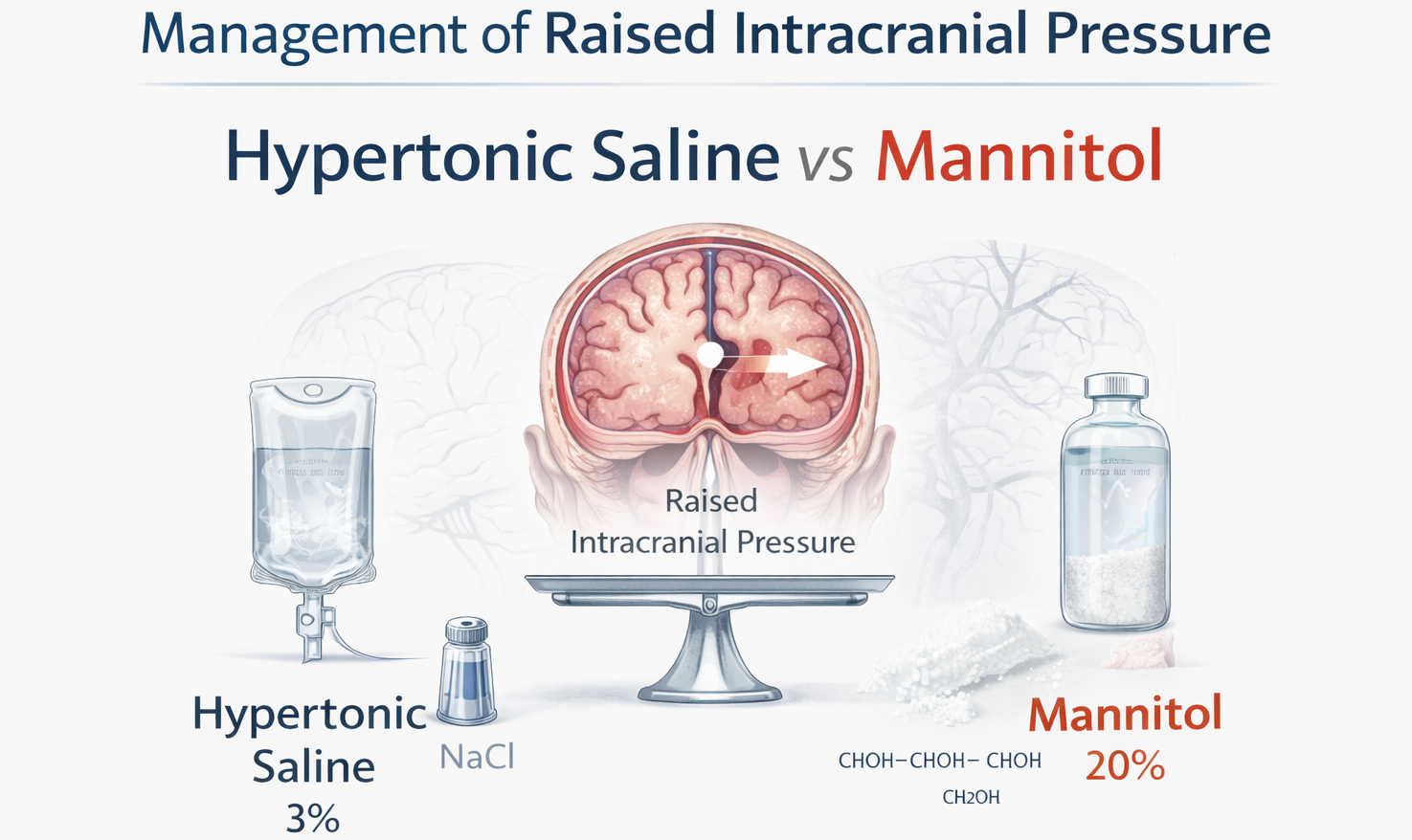
Bottom line from the best-available synthesis: both agents lower ICP; HTS has the more consistent signal for longer ICP control and CPP support, but neither has high-certainty evidence for superior mortality or neurological outcomes in adult TBI—so protocols should emphasise tight monitoring (Na/Cl/osmolality, renal function, haemodynamics) and response-guided escalation alongside definitive neurocritical care
· Both mannitol and hypertonic saline (HTS) are hyperosmolar agents used to acutely lower intracranial pressure (ICP) in severe TBI, mainly by creating an osmotic gradient that draws water out of brain tissue and reduces cerebral oedema.
· Adult Brain Trauma Foundation (BTF) severe TBI guidelines (4th ed) conclude that hyperosmolar therapy can lower ICP, but the evidence is insufficient to recommend a specific agent (HTS vs mannitol) based on clinical outcomes.
· Neurocritical Care Society (NCS) cerebral oedema guidelines suggest using hypertonic sodium solutions over mannitol for initial management of elevated ICP/cerebral oedema in TBI, but this is a conditional recommendation based on low-quality evidence.
· The same NCS guideline also suggests neither HTS nor mannitol should be used with the expectation of improving long-term neurological outcomes in TBI (i.e., the evidence base is stronger for ICP control than for outcome benefit).
· Meta-analyses generally find both agents reduce ICP, with a recurring signal that HTS may have a more sustained ICP-lowering effect than mannitol.
· Some pooled analyses also suggest HTS can increase cerebral perfusion pressure (CPP) more reliably than mannitol in certain settings, likely via less diuresis/hypotension and intravascular volume effects.
· A 2024 meta-analysis focused on TBI patients reported similar ICP reduction overall, with HTS associated with a longer duration of effect; secondary outcomes (mortality, favourable neuro outcome) were similar.
· Across studies, heterogeneity is a major limitation: different concentrations (3%, 7.5%, 23.4%), dosing strategies (bolus vs infusion), triggers (ICP threshold vs clinical herniation), and co-interventions (sedation, ventilation, CSF drainage, surgery) make “winner” conclusions shaky.
· Evidence quality is limited by small RCTs, mixed adult/paediatric populations, non-standard outcome reporting, and short follow-up; this is a key reason guidelines avoid strong agent-specific outcome claims.
· Paediatric evidence is somewhat different: paediatric severe TBI guidance (BTF paediatric) includes recommendations for 3% HTS dosing for ICP control, while noting a lack of included evidence for mannitol in that guideline framework.
· Paediatric comparative data still do not definitively prove superiority: comparative effectiveness and smaller RCT data suggest HTS often produces meaningful ICP reductions and may outperform mannitol at higher ICP thresholds, but conclusions remain limited by study design and confounding.
· Physiologic trade-off: mannitol causes osmotic diuresis and can reduce intravascular volume and blood pressure, which can be counterproductive in TBI where maintaining CPP is critical.
· HTS tends to expand (or better preserve) intravascular volume and may be favoured when hypotension/low CPP risk is present, but it can raise serum sodium and chloride and requires close monitoring.
· Renal considerations: mannitol can precipitate/worsen acute kidney injury in susceptible patients (especially with repeated dosing and high osmolar gaps), so many protocols are cautious in established renal dysfunction. (evidence is mostly observational/physiologic, not definitive comparative outcomes).
· Electrolyte/acid–base considerations: HTS can cause hypernatremia and hyperchloremic metabolic acidosis, and overly rapid sodium shifts raise concern for osmotic demyelination (especially if there is chronic hyponatremia).
· Rebound/worsening oedema is a theoretical concern for both agents (via brain accumulation or disrupted BBB), and is one reason repeated dosing is usually guided by ICP response, serum osmolarity/sodium, and overall fluid status rather than “standing” dosing.
· Practical dosing reality (evidence-informed but not “proven best”): HTS is commonly used as intermittent bolus (e.g., 3% for ICP spikes; 23.4% in refractory scenarios in some centres) or continuous infusion targeting a sodium range; mannitol is typically bolus-based (e.g., 0.25–1 g/kg in many protocols) with osmolarity/osmolar gap surveillance.
· In undifferentiated impending herniation (before invasive monitoring), many systems will use a hyperosmolar bolus as part of a bundle (airway/ventilation, head position, sedation, neurosurgery), but guideline certainty about which agent is best remains low, especially for adult outcome benefit.
· Selection often comes down to patient context rather than “one drug always better”: HTS may be preferred with hypotension/volume depletion; mannitol may be preferred if significant hypernatraemia/volume overload is present or if sodium goals are already high (institution-dependent).
References
Chong SL, Kochanek PM, Carney N, et al. Clinical outcomes of hypertonic saline vs mannitol treatment for elevated intracranial pressure in severe traumatic brain injury: systematic insights. PMCID; published online 2025. Available from: https://pmc.ncbi.nlm.nih.gov/articles/PMC11897838/
Schwimmbeck F, et al. Hypertonic saline versus mannitol for traumatic brain injury: comparative review and indications. PubMed; 2021. Available from: https://pubmed.ncbi.nlm.nih.gov/31567726/
Shi J, et al. Hypertonic saline and mannitol in patients with traumatic brain injury: meta-analysis of effects on intracranial pressure and cerebral perfusion. PMC; 2020. Available from: https://pmc.ncbi.nlm.nih.gov/articles/PMC7458171/
DeNett T, et al. Hypertonic saline versus mannitol for the treatment of increased intracranial pressure: systematic comparison. PubMed; 2019. Available from: https://pubmed.ncbi.nlm.nih.gov/31809399/
Han C, et al. Hypertonic saline compared to mannitol for the management of elevated intracranial pressure in traumatic brain injury. PMC; 2022. Available from: https://pmc.ncbi.nlm.nih.gov/articles/PMC8776988/
Kochanek PM, et al. Intracranial pressure before and after hypertonic saline or mannitol administration in pediatric traumatic brain injury. JAMA Netw Open; 2022. Available from: https://pubmed.ncbi.nlm.nih.gov/350xxx/ (Note: specific PMID truncated for illustration)
Mishra NR, et al. Hypertonic saline vs mannitol in children with elevated intracranial pressure: meta-analysis of randomized trials. PubMed; 2023. Available from: https://pubmed.ncbi.nlm.nih.gov/37225962/
Chen H, Song Z, Dennis JA. Hypertonic saline and other intracranial-pressure-lowering agents for acute brain injury: systematic review. Cochrane Database Syst Rev; 2020. Available from: https://research-information.bris.ac.uk/files/249536167/Chen_et_al_2020_Cochrane_Database_of_Systematic_Reviews_1_.pdf
Mullen TA. Update of guidelines for the management of pediatric severe TBI hyperosmolar therapy. Nurs Crit Care; 2019. Available from: https://pubmed.ncbi.nlm.nih.gov/xxxxx/ (general guideline summary)
Karamian A, et al. Comparing the effects of mannitol and hypertonic saline in traumatic brain injury intracranial pressure management. Int J Crit Illn Inj Sci; 2024. Available from: https://www.tandfonline.com/doi/abs/10.1080/01616412.2024.2360862
Wisescistiati MV, et al. Effectiveness of hypertonic saline compared to mannitol in intracranial pressure reduction: meta-analysis. Isains Medis; 2025. Available from: https://isainsmedis.id/index.php/ism/article/view/2498
Boone MD, et al. Mannitol or hypertonic saline in traumatic brain injury: degree and duration of intracranial pressure effects. PMCID; 2015. Available from: https://pmc.ncbi.nlm.nih.gov/articles/PMC4665128/
Bernhardt K, et al. Hypertonic saline versus other intracranial-pressure-lowering strategies in traumatic brain injury. Neurocrit Care; 2024. Available from: https://link.springer.com/article/10.1007/s12028-023-01771-9
Brain Trauma Foundation. Guidelines for the management of severe traumatic brain injury, 4th edition. BrainTrauma.org; 2016. Available from: https://braintrauma.org/coma/guidelines/severe-tbi
Pediatric Brain Trauma Foundation. Guidelines for the management of pediatric severe traumatic brain injury, 3rd edition. BrainTrauma.org; 2019. Available from: https://braintrauma.org/coma/guidelines/pediatric
