
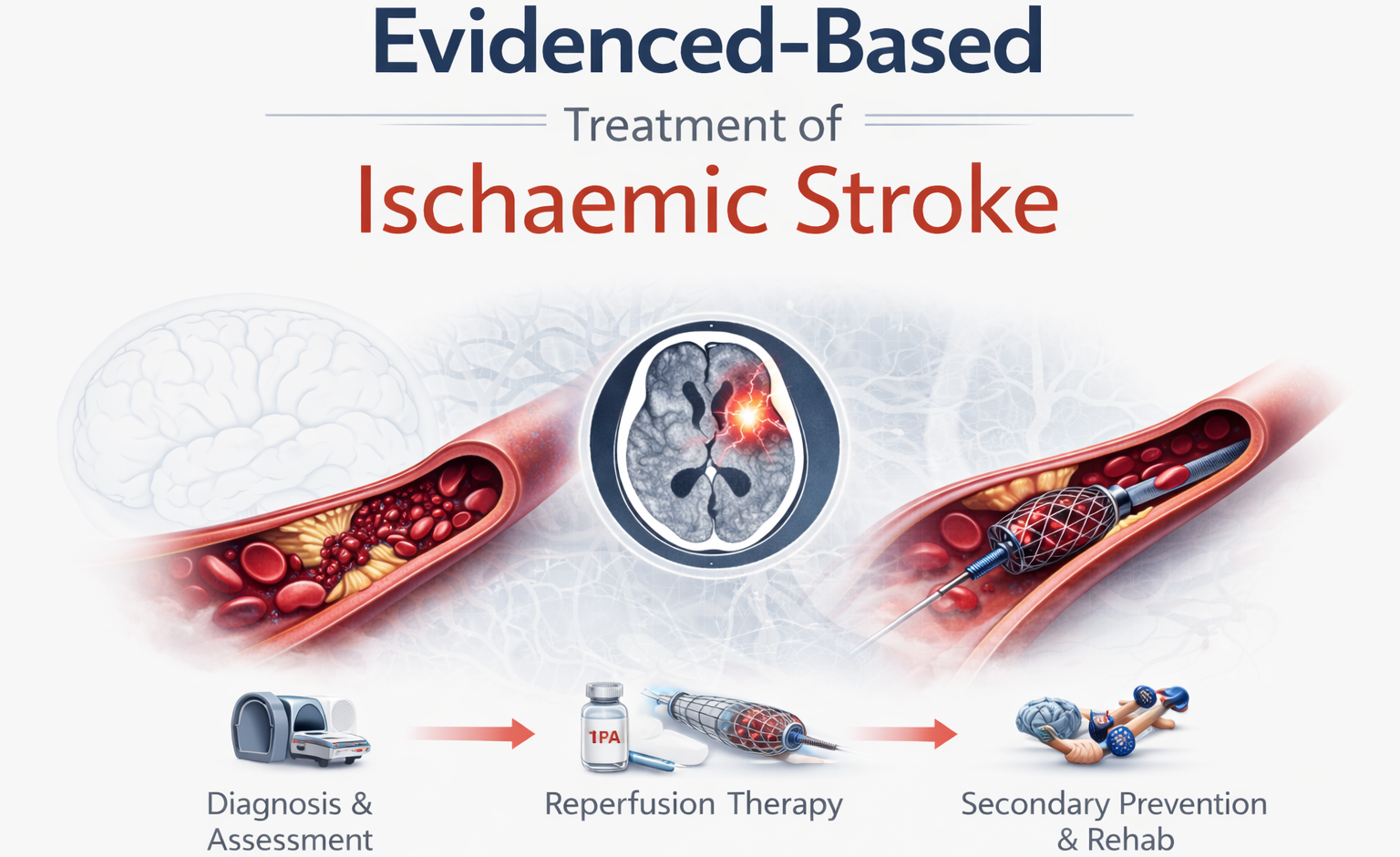
Intravenous Thrombolysis
- For patients with potentially disabling ischaemic stroke within 4.5 hours of
onset who meet specific eligibility criteria, intravenous thrombolysis should be
administered as early as possible after stroke onset (Wardlaw et al 2014 [39];
Emberson et al 2014 [40]) STRONG RECOMMENDATION
- For patients with potentially disabling ischaemic stroke who do not have
clinical or brain imaging contraindications, intravenous tenecteplase
(0.25mg/kg, maximum 25mg) should be administered up to 4.5 hours of
onset. If tenecteplase is not available then alteplase (0.9mg/kg, maximum
90mg) should be given. (Palaiodimou et al 2024 [512]; Meng et al 2024 [507];
Muir et al 2024 [510]; Parsons et al 2024 [450]; Campbell et al 2018 [55]; Qiu
et al 2025 [530]; Ma et al 2024 [460]; Emberson et al 2014 [40] STRONG
RECOMMENDATION
- For patients with potentially disabling ischaemic stroke who meet perfusion
mismatch criteria in addition to standard clinical criteria, tenecteplase (0.25
mg/kg) or intravenous alteplase (dose of 0.9 mg/kg) should be administered
up to 9 hours after the time the patient was last known to be well, or from the
midpoint of sleep for patients who wake with stroke symptoms, unless the
patient has a large vessel occlusion and immediate access to endovascular
therapy. (Campbell et al 2019 [58]; Palaiodimou et al 2024 [459]; Xiong et al
2024 [443], Zhou et al 2025 [549]) STRONG RECOMMENDATION
- For ischaemic stroke patients who received dabigatran pre-stroke,
intravenous thrombolysis can be administered after dabigatran reversal.
CONSENSUS BASED RECOMMENDATION
Endovascular Therapy
- For patients with a disabling clinical deficit due to ischaemic stroke caused by
a large vessel occlusion in the internal carotid artery, proximal middle cerebral
artery (M1 and proximal or dominant M2 segments), basilar artery occlusion,
or with tandem occlusion of both the cervical carotid and intracranial large
arteries, endovascular therapy should be undertaken when the procedure can
be commenced within 24 hours of stroke onset, taking into account individual
patient factors. Such factors include: extent and location of brain injury, pre-
morbid function, frailty, comorbidities, and patient’s and/or family’s wishes.
(Goyal et al 2016 [76]; Albers et al 2018 [92]; Nogueira et al 2018 [93]; Nogueira et al 2025 [524]; Yoshimura et al 2022 [305]; Sarraj et al 2023 [335], Huo et al 2023 [336] STRONG RECOMMENDATION
- Eligible stroke patients should receive intravenous thrombolysis while concurrently arranging endovascular therapy, with neither treatment delaying the other. (Goyal et al 2016 [76]; Majoie et al 2023 [397]; Qiu et al 2025 [530] STRONG RECOMMENDATION
Acute Antithrombotic Therapy
- Patients with ischaemic stroke who are not receiving reperfusion therapy
should receive antiplatelet therapy as soon as brain imaging has excluded
haemorrhage. (Sandercock et al 2014 [162] STRONG RECOMMENDATION
- Acute antiplatelet therapy should not be given within 24 hours of thrombolysis
administration with the exception of patients who require stent implantation as
part of acute stroke therapy. (Zinkstok et al 2012 [166]) STRONG
RECOMMENDATION AGAINST
- Routine use of anticoagulation in patients without cardioembolism (e.g. atrial
fibrillation) following TIA/stroke is not recommended. (Wang et al 2023 [390])
STRONG RECOMMENDATION AGAINST
- Aspirin plus clopidogrel should be commenced within 24 hours and used in
the short term (first three weeks) in patients with minor ischaemic stroke or
high-risk TIA to prevent stroke recurrence. (Hao et al 2018 [169]) STRONG
RECOMMENDATION
- Aspirin plus ticagrelor commenced within 24 hours may be used in the short
term (first 30 days) in patients with minor ischaemic stroke or high-risk TIA to
prevent stroke recurrence. (Johnston et al 2020 [174]) WEAK
RECOMMENDATION
Acute Blood Pressure Lowering Therapy
- Intensive blood pressure lowering in the acute phase of care to a target SBP
of < 140 mmHg is not recommended for patients with ischaemic stroke. (Chen
and Zhu 2024 [441]) STRONG RECOMMENDATION AGAINST
- In patients with acute intracerebral haemorrhage, early blood pressure
lowering should be undertaken with a target systolic blood pressure of 130 to
140 mmHg within one hour of commencing treatment. (Wang et al 2024 [440];
Ma et al 2023 [400]; Li et al 2024 [436]) STRONG RECOMMENDATION
- Patients with acute ischaemic stroke eligible for treatment with intravenous thrombolysis should have their blood pressure reduced to below 185/110mmHg before treatment and in the first 24 hours after treatment. CONSENSUS BASED RECOMMENDATION
- Patients with acute ischaemic stroke with blood pressure > 220/120 mmHg should have their blood pressure cautiously reduced (e.g. by no more than 20%) over the first 24 hours. CONSENSUS BASED RECOMMENDATION
Surgery for Acute Ischaemic Stroke
- Selected patients aged 60 years and under with malignant middle cerebral
artery territory infarction should undergo urgent neurosurgical assessment for
consideration of decompressive hemicraniectomy. When undertaken,
hemicraniectomy should ideally be performed within 48 hours of stroke onset.
(Cruz-Flores et al 2012 [192]; Reinink et al 2021 [197]) STRONG
RECOMMENDATION
Management of Cerebral Oedema
- Corticosteroids are not recommended for management of stroke patients with
brain oedema and raised intracranial pressure. (Sandercock et al 2011 [193])
WEAK RECOMMENDATION AGAINST
- In stroke patients with brain oedema and raised intracranial pressure,
osmotherapy and hyperventilation can be trialled while a neurosurgical
consultation is undertaken. CONSENSUS BASED RECOMMENDATION
Oxygen Therapy
- For acute stroke and Transient Ischaemic Attack (TIA) patients who have
SpO2 >92% on room air, the routine use of supplemental oxygen is not
recommended. (Chu et al 2018 [218]; Ding et al 2018 [219]) WEAK
RECOMMENDATION AGAINST
Glycaemic Therapy
- All stroke patients should have their blood glucose level monitored for the first
72 hours following admission, and appropriate glycaemic therapy instituted to
treat hyperglycaemia (glucose levels greater than 10 mmol/L), regardless of their diabetic status. (Middleton et al 2011 [254]) STRONG RECOMMENDATION
Fever Management
- All stroke patients should have their temperature monitored at least four times
a day for 72 hours. (Middleton et al 2011 [254]) STRONG
RECOMMENDATION
- Stroke patients with fever > 37.5 ºC may be treated with paracetamol as an
antipyretic therapy. (Chen et al 2018 [262]; Middleton et al 2011 [254]) WEAK
RECOMMENDATION
Head Position
- Patients with acute stroke, while in bed and not receiving nasogastric feeding,
may be managed in any position during the first 24 hours after hospital
admission. (Anderson et al 2017 [274]) WEAK RECOMMENDATION